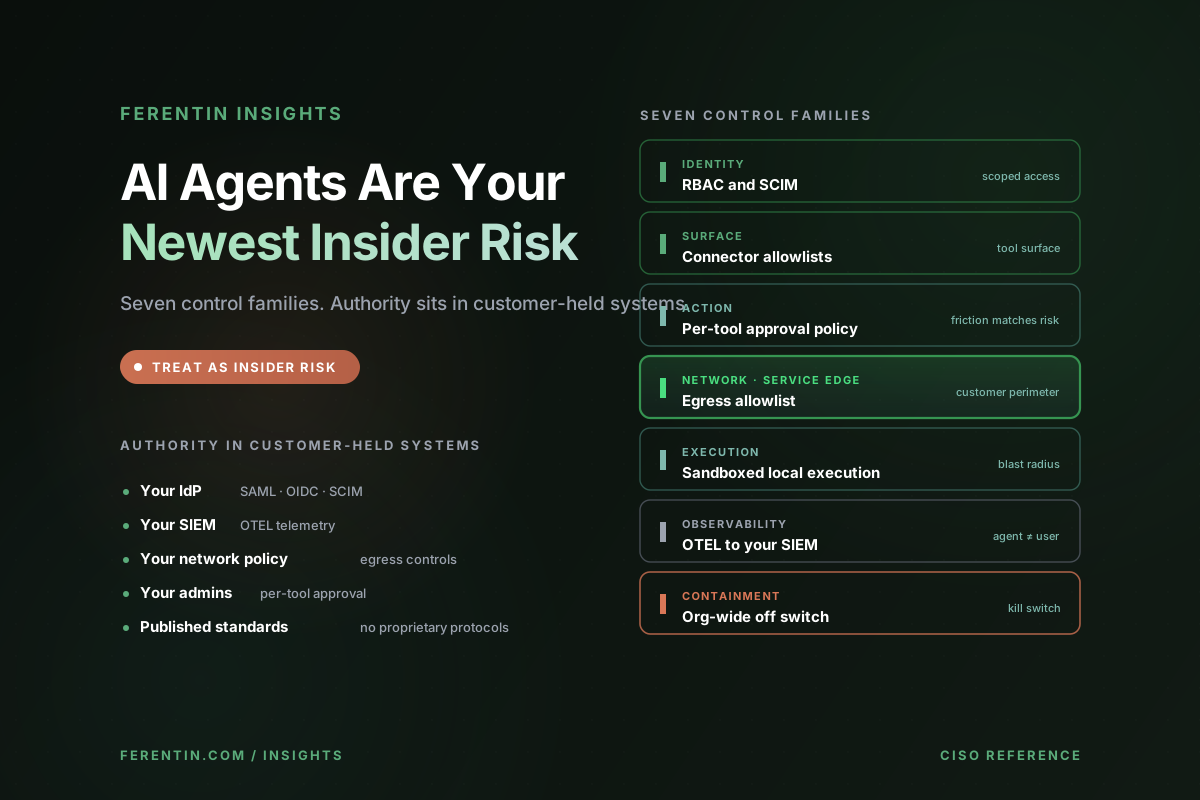
As LLMs spread across the enterprise, including assistants, co-pilots, IDE integrations, automation agents and custom LLM-based applications, organizations are effectively onboarding a new digital workforce. And like any workforce, these AI systems need identity, permission boundaries and oversight.
That is the essence of Zero Trust for AI. Traditional network perimeters assumed that anything inside the firewall could be trusted. Zero Trust flips that assumption: no entity, human or machine, is trusted by default. Every request must be authenticated, authorized and continuously validated. This article explains how these principles apply to the brains of the AI stack, the LLMs themselves, and why enterprises that skip this step are building on a foundation of implicit trust they cannot afford.
The LLM landscape is inconsistent by default
A decade ago, most enterprises had one or two cloud providers and a well-understood perimeter. Today, a single organization might rely on:
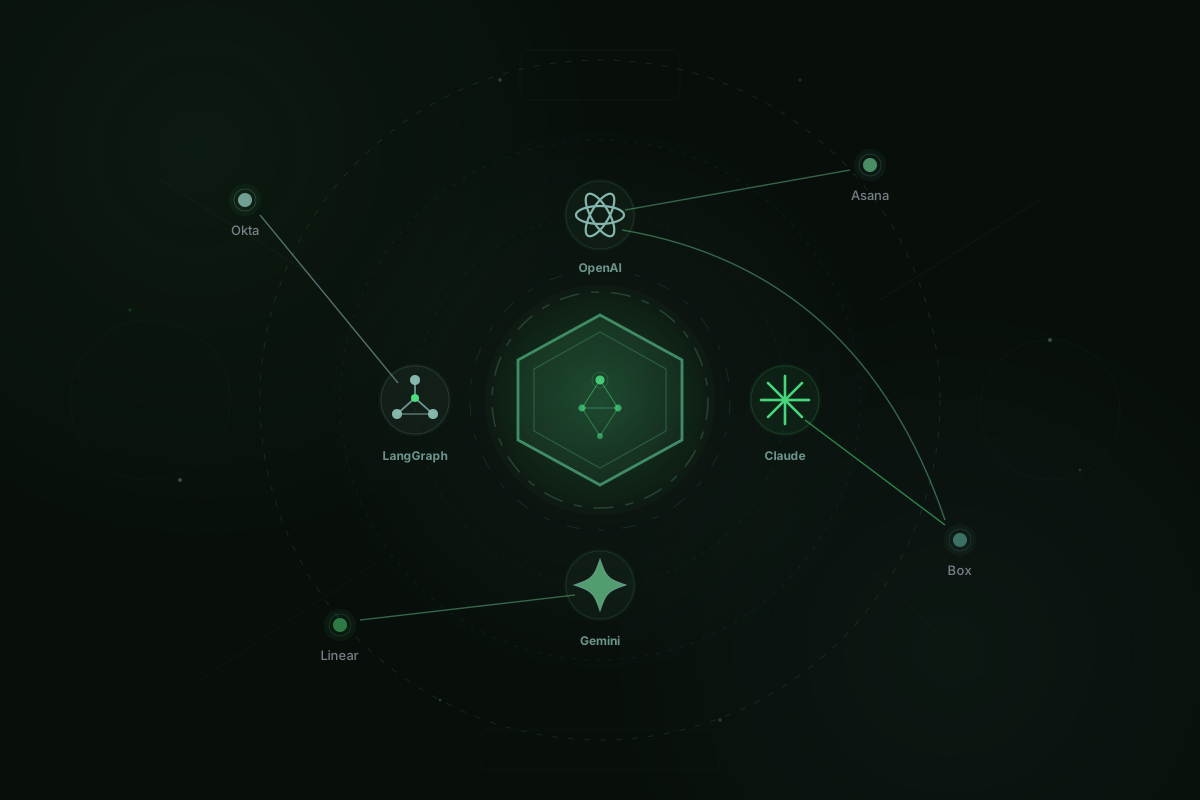
- Multiple LLM providers. OpenAI, Anthropic, Google, Mistral and others, each with different capabilities, pricing models and data handling policies.
- Various deployment models. Cloud APIs, on-premise deployments, fine-tuned models and hybrid setups where some workloads stay local and others reach external endpoints.
- Diverse use cases. From code generation to customer support, from financial analysis to internal knowledge retrieval, each with different sensitivity levels and compliance requirements.
This fragmentation creates security blind spots. Each provider has its own authentication mechanism, its own logging format and its own approach to data retention. A developer using Claude through an IDE plugin, a support agent using ChatGPT through a custom integration and a data team querying a self-hosted model are all interacting with LLMs, but through entirely different trust boundaries with no unified visibility.
Without a consistent security layer, the enterprise has no single answer to basic questions: Who is using which models? What data is being sent? Are our policies being enforced? The answer, for most organizations, is that they simply do not know.
Why traditional security falls short
Traditional perimeter-based security assumes a clear boundary between trusted and untrusted networks. Traffic inside the perimeter is trusted; traffic outside is not. But LLMs fundamentally break this model in several ways.
Data flows in both directions. Unlike a typical API call where you send a request and get a structured response, LLM interactions are conversational. Users send prompts that may contain sensitive business context, proprietary code, customer data, or strategic plans. The model returns responses that may synthesize or reflect that sensitive information. Every interaction is a potential data flow in both directions.
Context accumulates over time. A single prompt might seem innocuous. But conversation history builds up, and that accumulated context can contain far more sensitive information than any individual message. A developer asking an LLM to debug code might, over the course of a session, expose authentication logic, database schemas, API keys and internal architecture details. Traditional DLP tools, designed for structured data at rest, are not built to evaluate this kind of unstructured, conversational data flow.
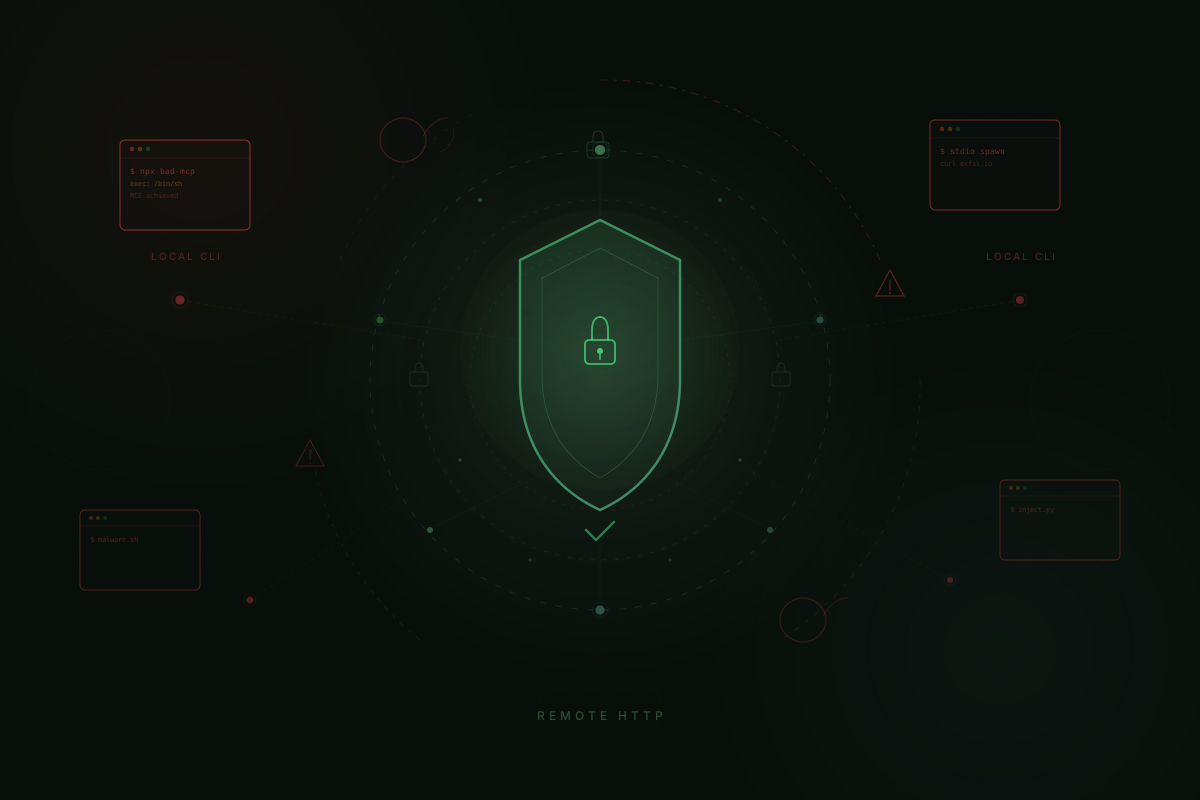
Tool access expands the attack surface. Modern LLM deployments increasingly include tool use, the ability for models to call functions, query databases, access APIs and interact with internal systems. An LLM with tool access is not just processing text; it is acting as an agent within your infrastructure. A compromised or misconfigured tool integration could allow data exfiltration, unauthorized actions, or lateral movement, risks that perimeter security was never designed to address.
The trust boundary is the identity, not the network. When a developer uses an LLM through their IDE, the request might traverse your corporate network, hit a cloud API and return through the same path. The network perimeter sees this as normal HTTPS traffic. The real question is not whether the traffic is on the right network. It is whether the person making the request is authorized to use that model, with those tools, for that purpose.
Zero Trust principles applied to LLMs
Zero Trust is not a product; it is an architectural philosophy formalized by NIST SP 800-207. The core principle of "never trust, always verify" translates into four concrete practices when applied to LLM infrastructure.
1. Identity verification for every request
Every request to an LLM should be authenticated and attributed to a specific user or service account. This sounds obvious, but it is rarely the reality. Most LLM integrations today use shared API keys. A single key for an entire team, or worse, a key embedded in application code.
Identity-based access changes the equation. When every request carries a verified identity, you gain:
- Audit trails for compliance. You can answer the question "who sent this prompt?" at any point in time, which is essential for regulated industries.
- Usage tracking and cost allocation. API costs can be attributed to teams, projects, or individuals rather than being an opaque line item.
- Access control enforcement. Policies can be applied per user or per role, not per API key. A junior developer and a security engineer should not have the same access to sensitive models.
The key insight is that identity should be federated from your existing identity provider, such as your SSO or directory service, rather than managed separately. LLM access should be an extension of your existing identity fabric, not a parallel system.
2. Least privilege access
Users and applications should only have access to the LLM capabilities they actually need. In practice, this means:
- Model-level restrictions. Not every user needs access to every model. An organization might restrict access to GPT-4 for production workloads while allowing GPT-3.5 for development, or limit certain teams to specific providers based on data handling requirements.
- Token budgets and rate limits. Uncontrolled LLM usage creates both cost risk and security risk. Per-user or per-team limits prevent runaway spending and provide an early warning signal for anomalous behavior.
- Tool and function access controls. If an LLM has access to a code execution tool, a database query tool and a file system tool, not every user should be able to invoke all three. Tool-level permissions ensure that the blast radius of any single session is bounded.
Least privilege is especially important for MCP (Model Context Protocol) servers, which give AI agents structured access to enterprise tools and data. Without fine-grained authorization, a single MCP connection can expose far more capability than any individual user should have.
3. Continuous monitoring and observability
Every interaction should be logged, stored and available for analysis. This is not just about security. It is about operational maturity. Continuous monitoring enables:
- Anomaly detection. A user who normally sends 50 requests per day suddenly sending 5,000 might indicate a compromised credential or an automated script gone wrong.
- Data exfiltration detection. Patterns like systematically querying an LLM about customer records, internal financials, or source code repositories can be flagged and investigated.
- Prompt injection detection. Monitoring for known injection patterns (OWASP LLM Top 10) and unexpected behavioral changes in model outputs helps catch attacks early, before they cause damage.
- Compliance reporting. Regulators increasingly expect organizations to demonstrate oversight of their AI systems. Comprehensive logs are the foundation for that reporting.
The challenge with LLM monitoring is that the data is unstructured. Traditional SIEM tools expect structured log events. LLM interactions are free-text conversations that require different analysis approaches, including semantic analysis, pattern matching and contextual evaluation rather than simple keyword filtering.
4. Policy enforcement at the proxy layer
Security policies should be enforced consistently, regardless of which LLM provider is being accessed or which application is making the request. This requires a proxy layer that sits between your users and the models:
- Content filtering. Policies that prevent certain topics or types of information from being sent to external models, applied uniformly.
- PII detection and redaction. Personally identifiable information can be detected and redacted before prompts leave your environment, reducing exposure risk.
- Compliance rule enforcement. Industry-specific requirements such as HIPAA for healthcare, SOX for financial services and GDPR for European operations can be codified as policies and enforced automatically.
- Model routing. Sensitive workloads can be automatically routed to on-premise models or approved providers, while less sensitive requests go to cloud APIs. The routing decision is made by policy, not by the end user.
The proxy layer is the enforcement point. Without it, policies exist only on paper.
The architecture: a unified security layer
The most effective way to implement Zero Trust for LLMs is to route all LLM traffic through a security-aware gateway that provides authentication, authorization, policy enforcement and observability in a single layer.
This gateway approach offers several architectural advantages. First, it decouples security from the application. Developers do not need to implement authentication, logging, or policy checks in every application that uses an LLM. The gateway handles it. Second, it provides a single point of visibility. Security teams get a unified view of all LLM usage across the organization, regardless of provider or application. Third, it enables consistent policy enforcement. A policy written once applies to every request, whether it comes from a Slack bot, an IDE plugin, or a custom application.
This is the approach we took when building Ferentin. Our platform provides a Zero Trust security layer across the complete AI stack, covering LLMs, MCP Servers and AI Clients, with identity-based access controls, comprehensive audit logging and policy enforcement that works across every provider and every use case.
Getting started with Zero Trust for LLMs
Implementing Zero Trust for LLMs does not require ripping out your existing infrastructure. Start with these steps:
- Inventory your LLM usage. Understand which models are being used, by whom and through which applications. You cannot secure what you cannot see.
- Centralize authentication. Move from shared API keys to identity-based access, federated from your existing identity provider.
- Establish baseline policies. Define which models, tools and data types are appropriate for which roles. Start with broad policies and refine over time.
- Deploy a proxy layer. Route LLM traffic through a gateway that can enforce your policies and provide visibility.
- Monitor and iterate. Use the observability data to understand usage patterns, detect anomalies and refine your policies.
Zero Trust is a journey, not a destination. The goal is not to lock down LLM usage. It is to enable it securely, with the confidence that comes from knowing exactly who is doing what, with which models and under what policies.
If you are evaluating how to secure your organization's AI infrastructure, we would welcome the conversation. Visit our Trust Center for details on our security posture, or book a demo to see how Ferentin implements Zero Trust across the AI stack.
Stay in the loop
Get the latest on enterprise AI security delivered to your inbox.